(a)

where 


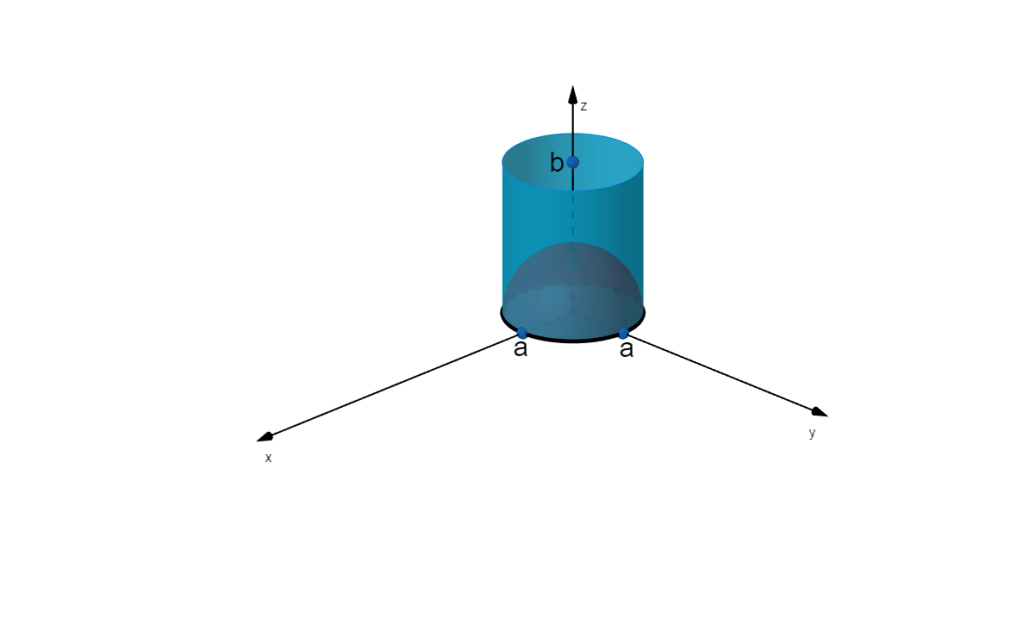
Each integral will be computed by appropriately parameterising the surface.
For


Change to plane polar coordinates

The angular integral is zero (integrating an odd function over a symmetric range). Hence

, using cylindrical polar coordinates


As above, the 

For

So
![\begin{aligned} I_3 &= \int\limits_{\theta=0}^{\pi/2}\int\limits_{\phi=-\pi}^{\pi}(a\cos\theta+a^3\sin^3\theta\sin\phi) a^2 \sin\theta d\theta d\phi \\ &= a^3\int\limits_{\theta=0}^{\pi/2}\int\limits_{\phi=-\pi}^{\pi} \sin\theta \cos\theta d\theta d\phi + a^5 \int\limits_{\theta=0}^{\pi/2}\int\limits_{\phi=-\pi}^{\pi} \sin^4\theta \sin\phi d\theta d\phi \\ &= 2\pi a^3 \left[ \frac{1}{2}\sin^2\theta \right]_{\theta=0}^{\pi/2} + a^5\int\limits_{\theta=0}^{\pi/2}\sin^4\theta d\theta \int\limits_{\phi=-\pi}^{\pi}\sin\phi d\phi \\ &= \pi a^3 + 0 \end{aligned}](https://s0.wp.com/latex.php?latex=%5Cbegin%7Baligned%7D+I_3+%26%3D+%5Cint%5Climits_%7B%5Ctheta%3D0%7D%5E%7B%5Cpi%2F2%7D%5Cint%5Climits_%7B%5Cphi%3D-%5Cpi%7D%5E%7B%5Cpi%7D%28a%5Ccos%5Ctheta%2Ba%5E3%5Csin%5E3%5Ctheta%5Csin%5Cphi%29+a%5E2+%5Csin%5Ctheta+d%5Ctheta+d%5Cphi+%5C%5C+%26%3D+a%5E3%5Cint%5Climits_%7B%5Ctheta%3D0%7D%5E%7B%5Cpi%2F2%7D%5Cint%5Climits_%7B%5Cphi%3D-%5Cpi%7D%5E%7B%5Cpi%7D+%5Csin%5Ctheta+%5Ccos%5Ctheta+d%5Ctheta+d%5Cphi+%2B+a%5E5+%5Cint%5Climits_%7B%5Ctheta%3D0%7D%5E%7B%5Cpi%2F2%7D%5Cint%5Climits_%7B%5Cphi%3D-%5Cpi%7D%5E%7B%5Cpi%7D+%5Csin%5E4%5Ctheta+%5Csin%5Cphi+d%5Ctheta+d%5Cphi+%5C%5C+%26%3D+2%5Cpi+a%5E3+%5Cleft%5B+%5Cfrac%7B1%7D%7B2%7D%5Csin%5E2%5Ctheta+%5Cright%5D_%7B%5Ctheta%3D0%7D%5E%7B%5Cpi%2F2%7D+%2B+a%5E5%5Cint%5Climits_%7B%5Ctheta%3D0%7D%5E%7B%5Cpi%2F2%7D%5Csin%5E4%5Ctheta+d%5Ctheta+%5Cint%5Climits_%7B%5Cphi%3D-%5Cpi%7D%5E%7B%5Cpi%7D%5Csin%5Cphi+d%5Cphi+%5C%5C+%26%3D+%5Cpi+a%5E3++%2B+0+%5Cend%7Baligned%7D+&bg=ffffff&fg=333A42&s=1&c=20201002)
because the integral over 
Finally we arrive at

![\begin{aligned}m &= \iiint \rho(r) dV \\ &= \int_{\phi=0}^{2\pi}\int_{\theta=0}^{\pi}\int_{r=0}^{a}(1+r)\, r^2 \sin\theta dr d\theta d\phi\\ &= \int_{\phi=0}^{2\pi} d\phi \int_{\theta=0}^{\pi} \sin\theta d\theta \left[ \frac{r^3}{3}+ \frac{r^4}{4} \right]_0^a \\ &= 4\pi \left( \frac{a^3}{3}+ \frac{a^4}{4} \right) \\ \end{aligned}](https://s0.wp.com/latex.php?latex=%5Cbegin%7Baligned%7Dm+%26%3D+%5Ciiint+%5Crho%28r%29+dV+%5C%5C+%26%3D+%5Cint_%7B%5Cphi%3D0%7D%5E%7B2%5Cpi%7D%5Cint_%7B%5Ctheta%3D0%7D%5E%7B%5Cpi%7D%5Cint_%7Br%3D0%7D%5E%7Ba%7D%281%2Br%29%5C%2C+r%5E2+%5Csin%5Ctheta+dr+d%5Ctheta+d%5Cphi%5C%5C+%26%3D+%5Cint_%7B%5Cphi%3D0%7D%5E%7B2%5Cpi%7D+d%5Cphi+%5Cint_%7B%5Ctheta%3D0%7D%5E%7B%5Cpi%7D+%5Csin%5Ctheta+d%5Ctheta++%5Cleft%5B+%5Cfrac%7Br%5E3%7D%7B3%7D%2B+%5Cfrac%7Br%5E4%7D%7B4%7D+%5Cright%5D_0%5Ea+%5C%5C+%26%3D+4%5Cpi+%5Cleft%28+%5Cfrac%7Ba%5E3%7D%7B3%7D%2B+%5Cfrac%7Ba%5E4%7D%7B4%7D+%5Cright%29+%5C%5C+%5Cend%7Baligned%7D+&bg=ffffff&fg=333A42&s=0&c=20201002)

 and
and 


 has occurred, then so has


 is a proper subset of

 and it’s derivatives. Differentiate (1)


![\begin{aligned} \int_\Gamma \mathbf{F} \cdot d\mathbf{x} &= \int_0^1 \begin{pmatrix} 2 \alpha t + \alpha^2 t + \alpha t \\ \alpha^2 t + \beta t \\ \alpha t + \beta t^2 \end{pmatrix} \cdot (1,1,1) \, dt \\ &= \int_0^1 (4\alpha t + 2 \alpha^2 t + \beta t + \beta t^2) \, dt \\ &= \left[ 2\alpha t^2 + \alpha^2 t^2 + \beta t^2/2 + \beta t^3/3 \right]_0^1 \\ &= 2\alpha + \alpha^2 + \beta /2 + \beta /3 \end{aligned}](https://s0.wp.com/latex.php?latex=%5Cbegin%7Baligned%7D+%5Cint_%5CGamma+%5Cmathbf%7BF%7D+%5Ccdot+d%5Cmathbf%7Bx%7D+%26%3D+%5Cint_0%5E1+%5Cbegin%7Bpmatrix%7D+2+%5Calpha+t+%2B+%5Calpha%5E2+t+%2B+%5Calpha+t+%5C%5C+%5Calpha%5E2+t+%2B+%5Cbeta+t+%5C%5C+%5Calpha+t+%2B+%5Cbeta+t%5E2+%5Cend%7Bpmatrix%7D+%5Ccdot+%281%2C1%2C1%29+%5C%2C+dt+%5C%5C+%26%3D+%5Cint_0%5E1+%284%5Calpha+t+%2B+2+%5Calpha%5E2+t+%2B+%5Cbeta+t+%2B+%5Cbeta+t%5E2%29+%5C%2C+dt+%5C%5C+%26%3D+%5Cleft%5B+2%5Calpha+t%5E2+%2B+%5Calpha%5E2+t%5E2+%2B+%5Cbeta+t%5E2%2F2+%2B+%5Cbeta+t%5E3%2F3+%5Cright%5D_0%5E1+%5C%5C+%26%3D+2%5Calpha+%2B+%5Calpha%5E2+%2B+%5Cbeta+%2F2+%2B+%5Cbeta+%2F3+%5Cend%7Baligned%7D+&bg=ffffff&fg=333A42&s=0&c=20201002)

 NST First Year Maths