
You can do this by substitution.
Let


This is probably the most compact form. Other forms are possible, for example by writing 
You can do this by substitution.
Let
This is probably the most compact form. Other forms are possible, for example by writing
(a)
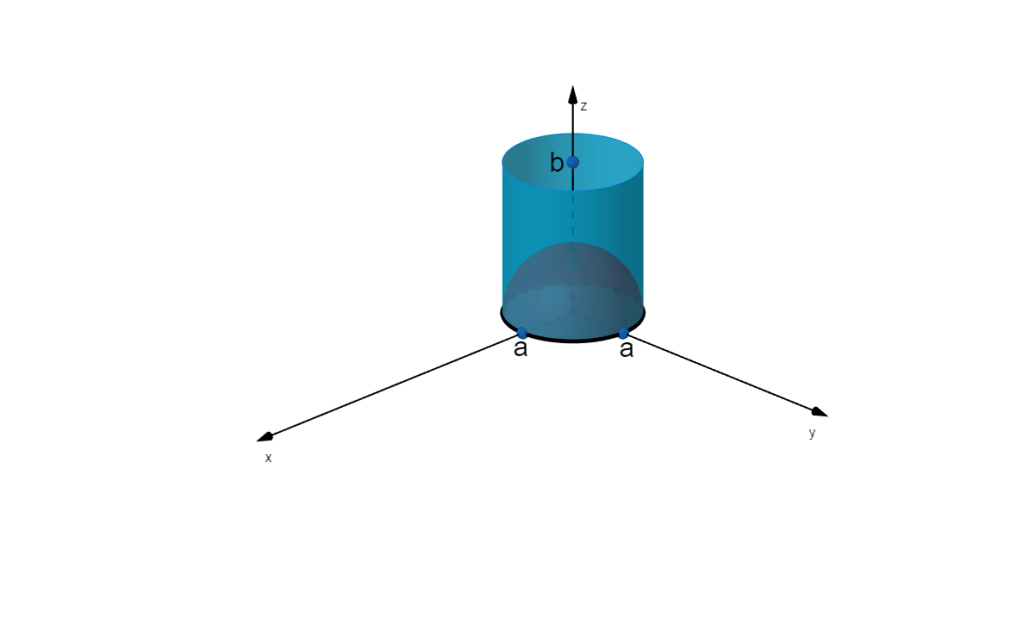
where 


Each integral will be computed by appropriately parameterising the surface.
For
Change to plane polar coordinates
The angular integral is zero (integrating an odd function over a symmetric range). Hence

, using cylindrical polar coordinates
As above, the 

For
So
because the integral over 
Finally we arrive at
(a)
(i)
As an intermediate result
(ii)
and 
(iii)
Use
Now
and the cofactor matrix is
Thus
This can easily be verified by multiplying by
(iv)
We know 
so finally
(a)
(i)
In Gaussian elimination, reduce the matrix to upper triangular form, then back-substitute.
Eliminate:
Back-substitute:
The solution is
(a)
Consider 


The polar angle is 
(b)
Let

Then
![\begin{aligned} V &=\int dV \\ &= \int_{z=0}^{a} \int_{\theta=0}^{\alpha} \int_{r=0}^{r_z} r dr d\theta dz \\ &= \int_{\theta=0}^{\alpha}d\theta \int_{z=0}^{a} \left[ r^2/2 \right]_0^{r_z} dz \\ &= \frac{\alpha}{2} b^2 \int_{z=0}^{a} 1-\frac{z}{a} dz \\ &=\frac{1}{2}\alpha b^2 \left[ z - \frac{z^2}{2a} \right]_0^{a} \\ &= \frac{1}{4} \, \alpha \, a \, b^2 \end{aligned}](https://s0.wp.com/latex.php?latex=%5Cbegin%7Baligned%7D+V+%26%3D%5Cint+dV+%5C%5C+%26%3D+%5Cint_%7Bz%3D0%7D%5E%7Ba%7D+%5Cint_%7B%5Ctheta%3D0%7D%5E%7B%5Calpha%7D+%5Cint_%7Br%3D0%7D%5E%7Br_z%7D+r+dr+d%5Ctheta+dz+%5C%5C+%26%3D+%5Cint_%7B%5Ctheta%3D0%7D%5E%7B%5Calpha%7Dd%5Ctheta+%5Cint_%7Bz%3D0%7D%5E%7Ba%7D+%5Cleft%5B+r%5E2%2F2+%5Cright%5D_0%5E%7Br_z%7D+dz+%5C%5C+%26%3D+%5Cfrac%7B%5Calpha%7D%7B2%7D+b%5E2+%5Cint_%7Bz%3D0%7D%5E%7Ba%7D+1-%5Cfrac%7Bz%7D%7Ba%7D+dz+%5C%5C+%26%3D%5Cfrac%7B1%7D%7B2%7D%5Calpha+b%5E2+%5Cleft%5B+z+-+%5Cfrac%7Bz%5E2%7D%7B2a%7D+%5Cright%5D_0%5E%7Ba%7D+%5C%5C+%26%3D+%5Cfrac%7B1%7D%7B4%7D+%5C%2C+%5Calpha+%5C%2C++a+%5C%2C++b%5E2++%5Cend%7Baligned%7D&bg=ffffff&fg=333A42&s=0&c=20201002)
(a)
The ‘trick’ is to re-write
which is the required Fourier series.
(b)
The derivative of 
which again is the required Fourier series.
(a)
Yes. A real symmetric matrix can be (orthogonally diagonalised).
(b)
No. This is a rotation matrix. The eigenvalues are non-real except for special values of 
(a)
(i)
If the formula isn’t known, it can be worked out using a basic formula you must know
Let 
Re-use the basic formula
Also since
then
Putting (2) and (3) in (1)
(ii)
If 
Or, a bit more algebraically
Consider the numerator on the RHS
as 

leading to the same answer as before.
(a)
The period 
(b)
Assuming such an expansion exists for
Substitute in (*)
This yields the constraints on the coefficients, by comparing constants, coefficients of 
Here, 


![\begin{aligned} I_3 &= \int\limits_{\theta=0}^{\pi/2}\int\limits_{\phi=-\pi}^{\pi}(a\cos\theta+a^3\sin^3\theta\sin\phi) a^2 \sin\theta d\theta d\phi \\ &= a^3\int\limits_{\theta=0}^{\pi/2}\int\limits_{\phi=-\pi}^{\pi} \sin\theta \cos\theta d\theta d\phi + a^5 \int\limits_{\theta=0}^{\pi/2}\int\limits_{\phi=-\pi}^{\pi} \sin^4\theta \sin\phi d\theta d\phi \\ &= 2\pi a^3 \left[ \frac{1}{2}\sin^2\theta \right]_{\theta=0}^{\pi/2} + a^5\int\limits_{\theta=0}^{\pi/2}\sin^4\theta d\theta \int\limits_{\phi=-\pi}^{\pi}\sin\phi d\phi \\ &= \pi a^3 + 0 \end{aligned}](https://s0.wp.com/latex.php?latex=%5Cbegin%7Baligned%7D+I_3+%26%3D+%5Cint%5Climits_%7B%5Ctheta%3D0%7D%5E%7B%5Cpi%2F2%7D%5Cint%5Climits_%7B%5Cphi%3D-%5Cpi%7D%5E%7B%5Cpi%7D%28a%5Ccos%5Ctheta%2Ba%5E3%5Csin%5E3%5Ctheta%5Csin%5Cphi%29+a%5E2+%5Csin%5Ctheta+d%5Ctheta+d%5Cphi+%5C%5C+%26%3D+a%5E3%5Cint%5Climits_%7B%5Ctheta%3D0%7D%5E%7B%5Cpi%2F2%7D%5Cint%5Climits_%7B%5Cphi%3D-%5Cpi%7D%5E%7B%5Cpi%7D+%5Csin%5Ctheta+%5Ccos%5Ctheta+d%5Ctheta+d%5Cphi+%2B+a%5E5+%5Cint%5Climits_%7B%5Ctheta%3D0%7D%5E%7B%5Cpi%2F2%7D%5Cint%5Climits_%7B%5Cphi%3D-%5Cpi%7D%5E%7B%5Cpi%7D+%5Csin%5E4%5Ctheta+%5Csin%5Cphi+d%5Ctheta+d%5Cphi+%5C%5C+%26%3D+2%5Cpi+a%5E3+%5Cleft%5B+%5Cfrac%7B1%7D%7B2%7D%5Csin%5E2%5Ctheta+%5Cright%5D_%7B%5Ctheta%3D0%7D%5E%7B%5Cpi%2F2%7D+%2B+a%5E5%5Cint%5Climits_%7B%5Ctheta%3D0%7D%5E%7B%5Cpi%2F2%7D%5Csin%5E4%5Ctheta+d%5Ctheta+%5Cint%5Climits_%7B%5Cphi%3D-%5Cpi%7D%5E%7B%5Cpi%7D%5Csin%5Cphi+d%5Cphi+%5C%5C+%26%3D+%5Cpi+a%5E3++%2B+0+%5Cend%7Baligned%7D+&bg=ffffff&fg=333A42&s=1&c=20201002)


![M^{-1} = \frac{1}{\text{det}M }\left[ \text{cof }M \right]^T](https://s0.wp.com/latex.php?latex=M%5E%7B-1%7D+%3D+%5Cfrac%7B1%7D%7B%5Ctext%7Bdet%7DM+%7D%5Cleft%5B+%5Ctext%7Bcof+%7DM+%5Cright%5D%5ET&bg=ffffff&fg=333A42&s=0&c=20201002)


![\begin{aligned}m &= \iiint \rho(r) dV \\ &= \int_{\phi=0}^{2\pi}\int_{\theta=0}^{\pi}\int_{r=0}^{a}(1+r)\, r^2 \sin\theta dr d\theta d\phi\\ &= \int_{\phi=0}^{2\pi} d\phi \int_{\theta=0}^{\pi} \sin\theta d\theta \left[ \frac{r^3}{3}+ \frac{r^4}{4} \right]_0^a \\ &= 4\pi \left( \frac{a^3}{3}+ \frac{a^4}{4} \right) \\ \end{aligned}](https://s0.wp.com/latex.php?latex=%5Cbegin%7Baligned%7Dm+%26%3D+%5Ciiint+%5Crho%28r%29+dV+%5C%5C+%26%3D+%5Cint_%7B%5Cphi%3D0%7D%5E%7B2%5Cpi%7D%5Cint_%7B%5Ctheta%3D0%7D%5E%7B%5Cpi%7D%5Cint_%7Br%3D0%7D%5E%7Ba%7D%281%2Br%29%5C%2C+r%5E2+%5Csin%5Ctheta+dr+d%5Ctheta+d%5Cphi%5C%5C+%26%3D+%5Cint_%7B%5Cphi%3D0%7D%5E%7B2%5Cpi%7D+d%5Cphi+%5Cint_%7B%5Ctheta%3D0%7D%5E%7B%5Cpi%7D+%5Csin%5Ctheta+d%5Ctheta++%5Cleft%5B+%5Cfrac%7Br%5E3%7D%7B3%7D%2B+%5Cfrac%7Br%5E4%7D%7B4%7D+%5Cright%5D_0%5Ea+%5C%5C+%26%3D+4%5Cpi+%5Cleft%28+%5Cfrac%7Ba%5E3%7D%7B3%7D%2B+%5Cfrac%7Ba%5E4%7D%7B4%7D+%5Cright%29+%5C%5C+%5Cend%7Baligned%7D+&bg=ffffff&fg=333A42&s=0&c=20201002)


 NST First Year Maths